
Style journal
1940s Utility Clothing: Britain’s Scheme and an American Contrast
In 1940s Britain, Utility was more than a description of practical clothes. It named a government scheme governing the production of consumer goods…
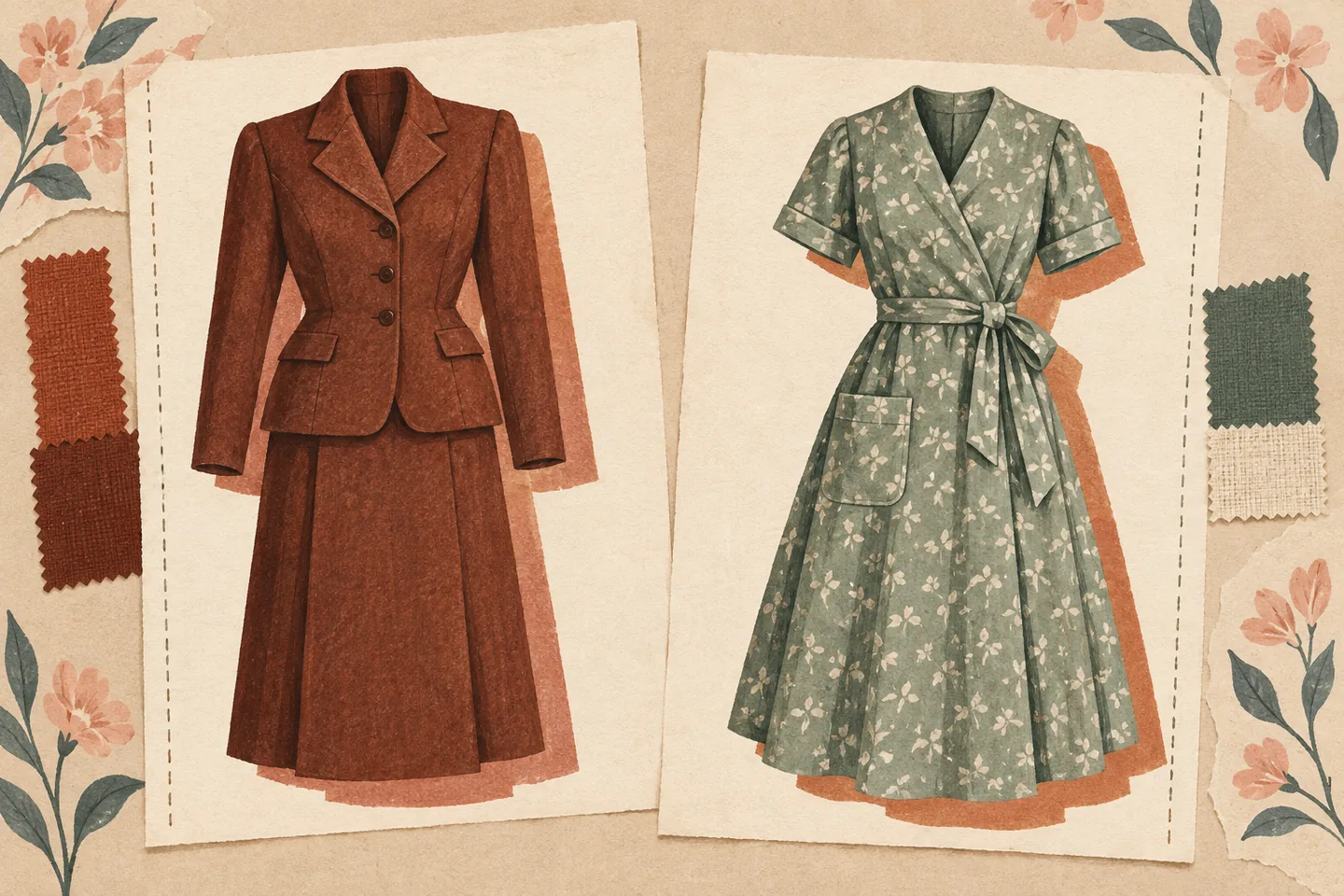
In 1940s Britain, Utility was more than a description of practical clothes. It named a government scheme governing the production of consumer goods during wartime shortages. A plain dress might have been useful without being a Utility garment, while an American dress described as a “utility garment” did not belong to the British scheme. The distinction matters when identifying surviving clothes: appearance can suggest how something was worn, but it cannot establish which rules governed its manufacture.
Two museum objects make a useful comparison. Aberdeen's museum records a wedding dress made to British Utility regulations, with traces of its CC41 label. The Metropolitan Museum of Art records Claire McCardell's American “Pop-over” of 1942, a practical dress described in a different commercial setting. Their records show how to separate a documented designation from a general idea of usefulness.
What British Utility meant
Britain introduced the Utility Scheme in 1941. The Victoria and Albert Museum describes it as a regulatory scheme intended to maintain access to consumer goods despite wartime cutbacks. Shortages and austerity continued to affect textile design after the war. The V&A’s account of post-war textiles provides that wider setting, but the existence of a scheme does not make every garment produced in the decade a Utility garment.
“Utility” also has an ordinary meaning. A garment can be sturdy, easy to move in or suitable for several uses, whether or not it was made under a government programme. The capitalised term points to the British scheme; a lower-case description may refer only to function. Neither a restrained shape nor a practical pocket can settle the question on its own. A label, an object record or reliable provenance gives a firmer basis for identifying a particular garment.
Rationing and Utility were separate questions
Rationing concerned what shoppers could purchase. During the war, buyers took ration books to shops and had coupons removed and cancelled when purchasing rationed clothing. Utility concerned production under a set of regulations. The two measures belonged to the same period of constraint, but a coupon book was not a Utility label. Knowing that someone bought clothes with coupons does not identify the rules under which any one garment was made.
Aberdeen's collection offers unusually concrete evidence. Its record says that a dress worn at a wedding in Scotland on 29 August 1942 was made to government Utility regulations. Remains of a CC41 label survive at the back. The dress is long and cream-coloured, with ruched panels and decorative triangular pockets. Aberdeen’s object record documents both the attribution and those visible details. The example shows that a Utility garment could have decorative features; a plain appearance was not the scheme's defining test.
The wedding dress also illustrates the limits of a visual shortcut. Without the museum's record and surviving label, its colour, length and pockets would tell a viewer about the garment's form, but not its regulatory history. The same applies in reverse: a simple day dress might look like a familiar image of wartime economy yet have been made at home, altered from older clothing or produced elsewhere. The evidence for its origin has to come from more than resemblance.
How to read a British garment record
Start with what a record actually states. Check its country, material and date, then look for an identified maker, a surviving mark or an explicit Utility attribution. A precise date and a broad decade range carry different weight. So do “associated with Utility” and “made to Utility regulations”. If the record only establishes that a garment is British and from the 1940s, describe it that way rather than adding CC41 to the label.
The V&A offers a useful reminder of that limit. Its fashion quiz identifies a wool suit as belonging to the 1940s, but the quiz does not say that the suit was made under the Utility Scheme. The V&A’s identification of the suit supports a decade, not a regulatory classification. A photograph or short caption may be enough to place an object in a period while leaving its manufacture, purchaser and later use unknown.
Once the recorded facts are clear, describe visible construction separately. Fabric, fastenings, pockets, seams and cut can help explain how a garment worked or why it suited a wearer. Those observations are valuable without being proof of a government designation. This order of reading prevents the historical background from doing more work than the object evidence permits.
The American “Pop-over”
The Met identifies its cotton “Pop-over” as designed by Claire McCardell, manufactured by Townley Frocks in the United States and dated to 1942. Its account describes a wraparound dress with a large pocket and refers to a fashion photograph showing it in a domestic setting. The museum also reproduces a period account that called the dress a “utility garment” in its American commercial context. The Met’s object record provides the designer, manufacturer, date and description. It does not place the dress under British Utility regulations.
That wording calls for care. The American use of “utility garment” helps explain how the “Pop-over” was presented, but it is not evidence of a CC41 label. It should not be translated into a British classification simply because the garments share a decade and a concern with practical wear. The American dress has its own documented maker and design context, which are more informative than an imported label.
Nor does the comparison divide the two countries into practicality on one side and style on the other. Aberdeen's Utility wedding dress has decorative ruching and pockets. McCardell's dress was described through both its usefulness and its appearance. Those details show that practical design and visual interest could coexist in either setting. The meaningful difference is what each museum can document about the garment's origin and classification.
Identifying an unlabelled 1940s dress
For an unlabelled object, begin with the narrowest supported description. Record the location and date if known, noting whether either is approximate. Check whether a maker or retailer is documented, and whether there is a photograph, purchase record, family history or surviving mark that connects the garment to a particular scheme. Do not turn an absence of such evidence into a claim that the dress was outside Utility; it may simply remain unclassified.
Then describe what can be seen: the fabric, length, closure, pocket placement and any alterations. These features can help distinguish an original design from later changes, though they do not by themselves establish where the garment was sold. If a collection uses “utility” in its ordinary sense, quote or paraphrase the context accurately and keep it separate from the British proper name. The same caution applies to “make do and mend”, which describes a different activity from buying a new garment made to Utility regulations.
Where a record combines a broad date with a confident attribution, keep both qualifications in the description. Where it names a designer but says nothing about a purchaser, avoid inventing a wearer's story. A useful catalogue entry can state what is known, identify what remains uncertain and still explain why the garment matters to the comparison.
The Aberdeen dress and McCardell's “Pop-over” therefore answer different questions. One has direct evidence of British Utility manufacture; the other has an American designer, manufacturer and practical description. For a third garment, follow whichever kind of evidence actually survives. That approach preserves what is distinctive about each object without making a simple 1940s silhouette carry a history it cannot prove.