
Style journal
1930s Fashion
By Keiko Martin
1930s fashion is recognised for natural waistlines, longer skirts, fluid evening dresses and increasingly defined shoulders. These features marked a…
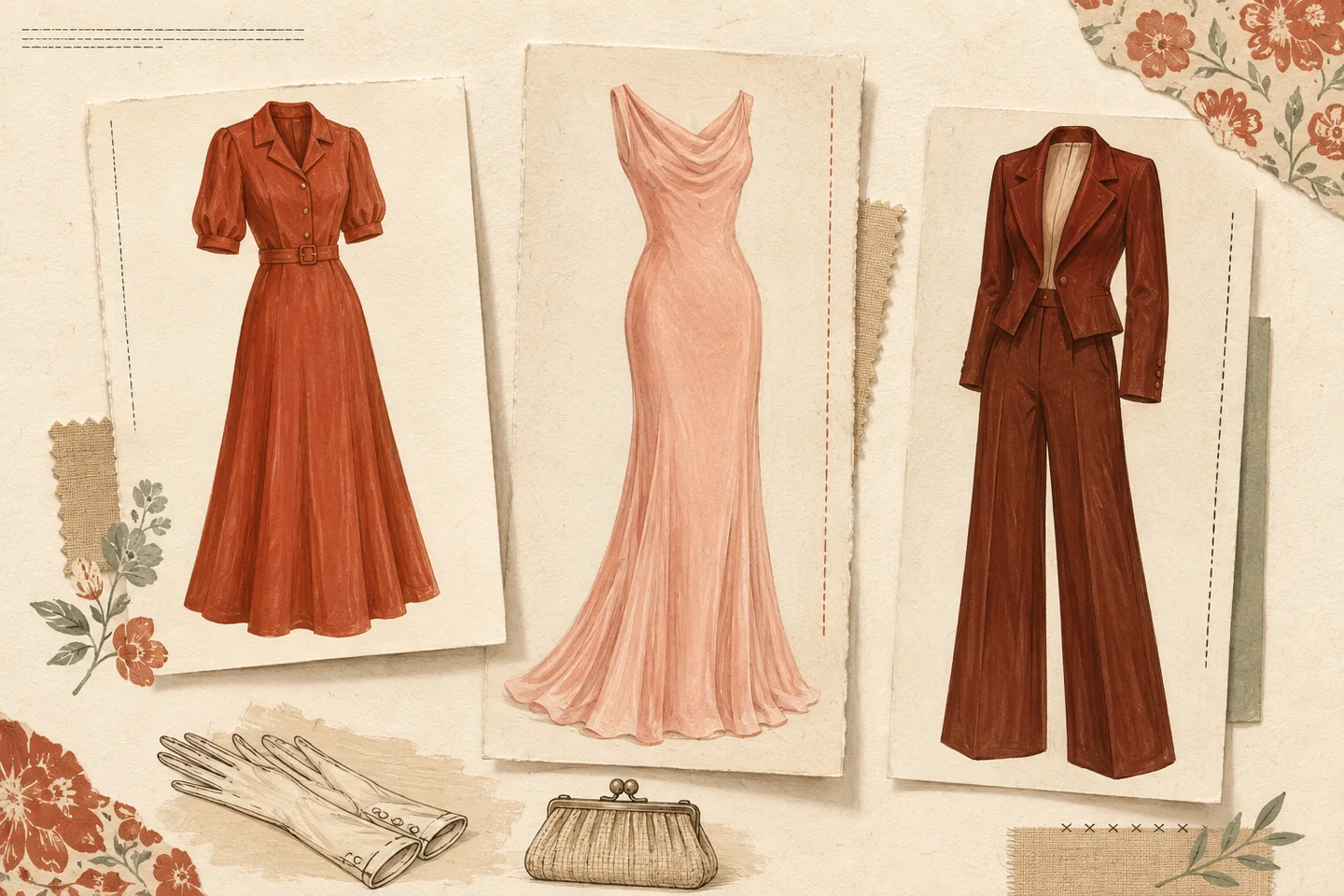
1930s fashion is recognised for natural waistlines, longer skirts, fluid evening dresses and increasingly defined shoulders. These features marked a shift from the straighter, lower-waisted shapes associated with the 1920s. They did not create a single uniform wardrobe: work, income, location and occasion all affected what people wore.
This guide focuses on Western fashion, especially the silhouettes found in period photographs and surviving garments. It separates daywear from evening dress and explains how to use those proportions in an outfit without relying on a named designer, elaborate costume or collection of accessories.
Recognising the silhouette
Start with the relationship between shoulder, waist and hem. Many dresses placed the waist near its natural position and followed the torso before widening into a skirt. Daytime hems generally sat below the knee, while formal evening dresses could reach the floor. A longer hem alone does not identify the period; neckline, sleeve shape and construction matter too.
Softness and structure often appeared together. A fitted waist might sit below gathered sleeves, a cape-like collar or a tailored shoulder. Skirts could gain movement through panels, pleats or a flare below the hip. These details changed across the decade, so avoid treating every early and late example as interchangeable.
For a dated overview, compare the day and evening silhouettes in its 1930–1939 fashion timeline. When looking at an illustration, remember that drawn proportions may exaggerate height and slenderness. Use photographs and garment measurements to understand how clothing actually fits a body.
What bias cutting does
A bias cut places pattern pieces diagonally across the fabric's grain. This allows a woven cloth to stretch and drape differently from a piece cut along its length or width. In eveningwear, the result can be a dress that follows the body softly rather than holding a rigid outline.
Bias cut does not mean tight. A garment needs enough room to settle without pulling across the hips or twisting at the seams. Diagonal drag lines, a rising hem or strained stitching suggest a fit problem. Check the dress while standing, sitting and walking; an attractive pose can hide restricted movement.
Fabric and cut are separate choices. Satin describes a weave, not a fibre, and a shiny surface does not prove that a dress is bias-cut. Examine how the material falls and where the seams run instead of choosing by gloss alone. A matt fabric can give an equally clear impression of the period's fluid line.
Daywear and practical layers
Day dresses could combine shaped waists with collars, buttoned fronts, patterned fabric and manageable skirts. Florals, checks, dots and stripes offered variety, while tucks or small gathers added interest without requiring heavy decoration. Sleeve length and fabric weight depended on season and purpose.
Separate skirts and blouses, knitted tops and tailored jackets provide another useful reference. For a modern interpretation, begin with a skirt that hangs cleanly from the waist and add a blouse with enough room through the shoulders. Tucking the blouse in makes the waist position visible without needing a tightly cinched belt.
A jacket should work with the layers underneath it. Try it over the blouse or knitwear you intend to wear, then reach forwards and bend your elbows. If the shoulder line collapses or the front pulls open, a different cut may work better than a larger size of the same jacket.
Study tailoring as construction rather than as a label. Look at the balance between shoulder width, lapel shape and waist suppression in this Metropolitan Museum of Art collection record. A museum garment is a reference for close observation, not proof that everyone dressed that way.
Evening dress and screen influence
Eveningwear used longer lines, draped necklines, low backs and fabrics that caught light or moved freely. Not every gown included all these features. A restrained front could accompany an open back, while a simple skirt allowed gathered fabric at the neckline to become the main detail.
Cinema helped circulate ideas about evening glamour and shaped references for ready-to-wear clothing. The relationship between screen imagery and everyday fashion is explored in its history of ready-to-wear fashion. Screen costumes remain selective evidence: lighting, performance and storytelling can favour clothes that would be inconvenient outside a film.
For an evening outfit, choose the feature that suits the setting. A softly draped neckline can work with a covered back; a long skirt can have enough width for stairs and dancing. Test any fastening you cannot easily reach, and check whether your intended underlayers remain covered as you move.
Menswear and leisure clothing
Menswear offers a different route into the decade. Suits, sports jackets, knitted layers and fuller trousers are useful starting points. The overall effect depends on the trousers' rise and drape as much as the jacket's shoulders. Narrow modern trousers can change the balance even when the upper half looks period-inspired.
For a wearable combination, try higher-waisted trousers with a tucked shirt and a knitted layer or jacket. Check that the waistband is comfortable when seated and that the pockets lie flat. A fuller leg should fall cleanly rather than gather heavily over the shoe.
Leisure clothing is worth examining separately from formal portraits. An open collar, knitwear or relaxed jacket can suggest the period without a complete suit. Match the degree of formality across the outfit: rugged trousers and delicate evening accessories usually need more thought than a straightforward shirt and cardigan.
Accessories without overcrowding
Hats, gloves, handbags and shoes can clarify an outfit, but they need not all appear together. Begin with one accessory whose scale works with the clothing. A compact bag can leave a long dress's line visible, while a hat changes the balance around the face and shoulders.
For footwear research, examine shape, fastening and proportions in its object record. For actual wear, prioritise a secure fit and a heel you can walk in. An accessory that requires constant adjustment distracts from the outfit and makes ordinary movement harder.
Colour photographs are not always available for historical references. A monochrome image can show contrast, texture and shape, but it cannot reliably tell you the original colour. Avoid assuming that a dark dress was black or that a pale garment was white.
Putting together an outfit
Build around an occasion and a single principal garment. This keeps choices practical and makes it easier to see which detail is missing.
- For daytime: combine a below-knee skirt, tucked blouse and cardigan. Check that the waist remains visible and the layers do not bunch.
- For tailored dress: pair fuller trousers or a skirt with a shaped jacket. Balance shoulder width against the volume below the waist.
- For evening: choose a fluid dress with one clear detail, such as a draped neckline. Add shoes that accommodate the hem length.
- For historical costume: select a particular year, place and occasion before gathering references. Keep those references consistent.
Before wearing the finished outfit, sit down, take a full stride and reach for something above shoulder height. Check hems with the intended shoes and inspect closures for strain. If using an older garment, look for weakened seams, thinning fabric and previous repairs before putting it under tension. Reproductions or modern separates may be more suitable for repeated wear than fragile originals.