Style journal
1910s Fashion
By Keiko Martin
Fashion in the 1910s changed noticeably between the decorative years before the First World War and the more practical years shaped by wartime…
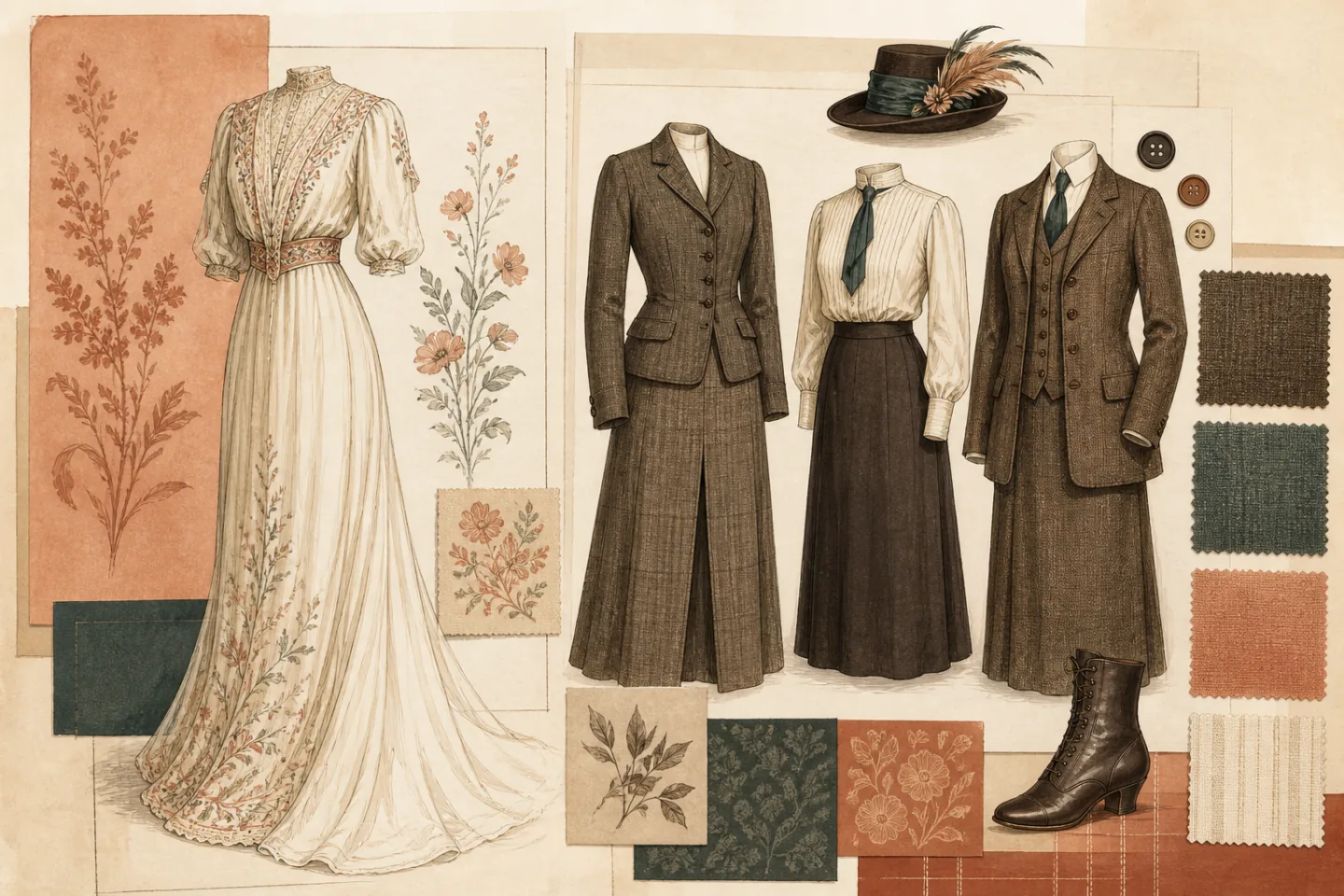
Fashion in the 1910s changed noticeably between the decorative years before the First World War and the more practical years shaped by wartime conditions. The decade did not produce one fixed look. Women’s dress moved from long, narrow skirts and elaborate surface detail towards shorter hems, simpler lines and clothes suited to work and travel. Men’s clothing changed less dramatically, but everyday suits and sturdy outerwear became increasingly important. A useful overview of the decade begins with its changing silhouette, then considers fabric, colour, accessories and social setting.
The changing silhouette
At the start of the decade, women’s clothing still carried features associated with late Edwardian dress. Skirts reached the floor or ankle, bodices were fitted, and hats could be broad and heavily trimmed. The pronounced forward-thrusting shape of the previous period was fading, however. Waistlines rose or softened, bodices became less rigid, and the overall line grew straighter. The 1910–1919 fashion history shows how quickly these proportions changed across daywear, evening dress and outerwear.
Narrow skirts were a striking early-decade feature. Some tapered so closely at the ankle that they limited the wearer’s stride. Tunics, overskirts and draped panels added interest above this narrow base. Although fashionable gowns sometimes appeared to hang freely, foundation garments were still common. The difference lay in the shape they supported: a longer, straighter torso rather than the exaggerated curves of the previous decade.
By the middle and later years, skirts generally allowed easier movement and showed more of the boot or stocking. Hemlines rose gradually rather than suddenly, commonly finishing around the ankle or lower calf by the end of the decade. Bodices remained modest by later standards, but softer blouses, practical shirtwaists and tailored jackets gave women a wider range of clothing for different kinds of daily activity.
Daywear, workwear and evening dress
A tailored skirt suit was a dependable choice for travel, shopping, office work and daytime visits. Its usual components were a long skirt and a structured jacket worn over a blouse. Wool suited cooler weather, while linen and cotton were useful in warmer months. Fit, fabric quality and finish distinguished an expensive suit from a modest one, but the basic combination appeared across social groups.
Working clothes depended on the task. Office and shop workers needed neat blouses and skirts, while factory, farm and service work called for washable fabrics, aprons, protective layers and sturdy footwear. Wartime employment made practical dress more visible, but it did not create a single universal uniform for civilian women. Local expectations, occupation, income and available materials continued to determine what was worn.
Evening dress remained more decorative. Silk, satin, chiffon and lace could be layered to create movement without heavy bulk. Beads, sequins, metallic thread, embroidery and fringe concentrated attention around a bodice, tunic edge or hem. Necklines were often lower than those of daytime garments, and short sleeves or transparent overlays exposed more of the arms. Wartime restraint affected access to materials, yet formal dress did not immediately lose colour or ornament.
Men’s clothing
For men, the three-piece lounge suit was central to ordinary respectable dress. It combined matching or coordinated trousers, waistcoat and jacket with a shirt, tie and hat. Jackets were generally cut close to the body without the extreme shaping seen in women’s dress. Dark wool worked for business and formal daytime use, while lighter cloth and paler colours appeared in summer and leisure settings.
Morning dress and evening dress followed more formal conventions, but many men owned fewer specialised outfits than elite etiquette suggested. A well-kept suit could serve several purposes by changing the shirt, tie, waistcoat or accessories. Flat caps, soft felt hats and straw hats belonged to different occupations, seasons and levels of formality. Boots remained common, while low shoes gained ground for town and indoor wear.
Military clothing also made functional details more familiar during the war. Belted coats, weather-resistant outer layers, practical pockets and subdued colours suited civilian life as well as service conditions. It is safer to identify a garment by its construction and context than to assume every belted coat or khaki item was directly copied from a uniform.
Fabric, colour and decoration
Fabric choice reveals both occasion and means. Wool was widely useful for suits, skirts, coats and men’s clothing. Cotton and linen served for blouses, undergarments, work clothes and summer dress. Silk and fine lace were associated with more costly or formal garments, although blended fabrics and careful trimming could imitate a luxurious effect. A surviving garment should therefore be judged by fibre, weave, construction and finish together, not by silhouette alone.
Pre-war wardrobes could include pale ivory, cream, rose, lilac and blue as well as saturated green, red, purple, gold and black. Colour did not vanish during wartime, but dark and muted shades became practical for work, mourning and repeated wear. Navy, brown, grey, black, khaki and dark green concealed dirt and coordinated easily. The division between restrained daywear and brighter evening clothes remained useful throughout the period.
Decoration often reinforced the long vertical line. Rows of buttons, braid, lace insertions, embroidery and beadwork drew the eye down a bodice or tunic. Tassels and fringe added movement, while fur, velvet and soutache gave winter clothing texture. Later garments were often plainer, yet economy did not mean an absence of design. Pleats, contrasting collars, cuffs and carefully placed fastenings could produce interest with little additional material.
Accessories and grooming
Hats were important to a complete outdoor outfit. Early examples could have wide brims, high crowns, feathers, ribbons, veiling or artificial flowers. Later hats tended to sit closer to the head and use less extravagant trimming. Straw, felt, velvet and silk suited different seasons. Hatpins secured larger styles, so surviving hats should be considered alongside the hairstyle and fastening method that supported them.
Gloves were worn for travel, visits and formal occasions. Compact frame bags, leather purses and drawstring reticules carried small personal items. Boots with laces or buttons protected the foot and ankle, while pumps and strapped shoes suited lighter or evening dress. As skirts shortened, stockings became a more visible part of the colour scheme rather than a mostly hidden necessity.
Women’s hair was commonly arranged in soft waves with a coil, braid or low gathered shape at the back. Hats covered much of the arrangement, making the visible front and side profile especially important. Jewellery included brooches, pendants, pearl strands, watch chains and small earrings. Daytime cosmetics were usually intended to appear restrained, although practice varied by age, setting and social convention.
Class, place and wartime change
Fashion illustrations often show elite clothing, but they are not a complete record of what most people wore. Wealthier households could maintain separate outfits for morning, visiting, travel, dinner and evening. People with smaller wardrobes repaired, altered and recombined garments. Rural work, urban employment, climate and local custom could matter more than a fashionable ideal published in a city.
The war accelerated changes already under way rather than replacing fashion overnight. Greater demand for practical clothing, limits on some materials, mourning and new forms of paid work all affected dress. The broad shift from pre-war elegance to wartime utility is summarised in Wikipedia’s overview, while a surviving transitional garment discussed by the Maryland Center for History and Culture demonstrates why close examination of construction is valuable.
Changes also differed between countries and communities. A date should not be assigned from one fashionable feature alone. An early-decade dress might be altered later, and an older style might remain in use long after magazines introduced a new silhouette. Photographs, labels, seams, fastenings, fabric and family records all help narrow the date.
How to recognise and use 1910s style
When identifying an outfit, begin with proportion. Look at the waist position, skirt width, hem length, shoulder line and relationship between bodice and overskirt. Then inspect practical details: how the garment closes, where it is reinforced, whether decoration is structural or applied, and what kind of underlayer would be needed to create its shape. Accessories can support a date, but they should not override evidence from the main garment.
For modern vintage-inspired dress, choose one or two clear references instead of recreating every historical layer. A softly draped blouse, long straight skirt, tailored jacket, restrained embroidery or small pendant can suggest the period while remaining comfortable. Pairing these details with contemporary shoes or trousers keeps the result distinct from costume. The most recognisable quality is not lavish decoration but the decade’s movement from narrow formality towards simpler, more mobile clothing.