Style journal
1910s Fashion Trends
By Keiko Martin
Fashion in the 1910s changed from the curved, highly structured look of the previous decade to straighter and more practical clothing. The change was…
Fashion in the 1910s changed from the curved, highly structured look of the previous decade to straighter and more practical clothing. The change was gradual rather than neat. Narrow skirts, raised waists and elaborate hats defined the early years, while fuller hems, tailored separates and simpler decoration became more common as the decade progressed.
Dress still depended on occasion, income, age and location. A formal evening gown did not represent what most people wore for work or household tasks, just as a city suit differed from country clothing. The clearest way to understand the period is to compare silhouette, construction and accessories rather than rely on a single fashionable image.
How the Silhouette Changed
The Long Line of the Early 1910s
At the start of the decade, women’s clothing retained high collars, fitted understructures and careful shaping. However, the pronounced forward bust and curved back associated with late Edwardian dress softened. Dresses increasingly followed a long, column-like line, often with a waist placed at the natural level or slightly above it.
Tunics, overskirts and draped panels added interest without creating a wide skirt. Soft fabric could cross the bodice, gather at one hip and fall vertically towards the ankle. Early-1910s fashion also used layered surfaces, contrasting textures and strong colour combinations, especially for evening dress.
The hobble skirt was the most extreme narrow shape. It fitted closely around the legs and tightened towards the hem, restricting the wearer’s stride. Some versions included pleats or openings for movement, but the outline remained impractical. Its importance lies less in how long it lasted than in how clearly it represents the early decade’s preference for a slim lower body.
Fuller and Shorter Skirts
By the middle of the decade, skirts widened and their hems rose enough to reveal more of the boot. Gathered or pleated skirts allowed easier walking, while belts and fitted bodices marked the waist. Jackets and tunics sometimes flared over the hips, producing a balanced shape without the heavy internal structures of earlier fashions.
There was no single moment when one outline replaced another. Surviving clothes and illustrations show overlap between narrow and full skirts, high and natural waists, and ornate and plain finishes. Accounts of how 1910–1920 fashion silhouettes evolved are most useful when treated as a sequence of tendencies rather than strict annual rules.
Women’s Everyday Clothing
Dresses, Blouses and Skirts
A day dress commonly combined a modest bodice, long sleeves and an ankle-length skirt. Tucks, covered buttons, lace inserts or a contrasting collar could decorate the upper body. Cotton and linen suited washable garments, while wool provided warmth and held the shape of skirts, jackets and coats.
Separate blouses and skirts were particularly useful because they allowed several combinations from a limited wardrobe. A light blouse could be worn under a dark jacket or with a walking skirt. Belts and sashes gave definition, and pleats or panels added room without making the garment bulky.
- For town wear: a tailored jacket, matching skirt, high-necked blouse, gloves and structured hat.
- For practical work: a washable blouse, plain skirt and sturdy lace-up or button boots.
- For travel: a long coat in durable cloth, a secure hat and a small handbag.
- For warm weather: lighter cotton or linen garments with less layered decoration.
These combinations help distinguish everyday dress from costume. Most outfits relied on proportion, fit and a few well-chosen details rather than continuous beadwork or theatrical trim.
Evening Dress
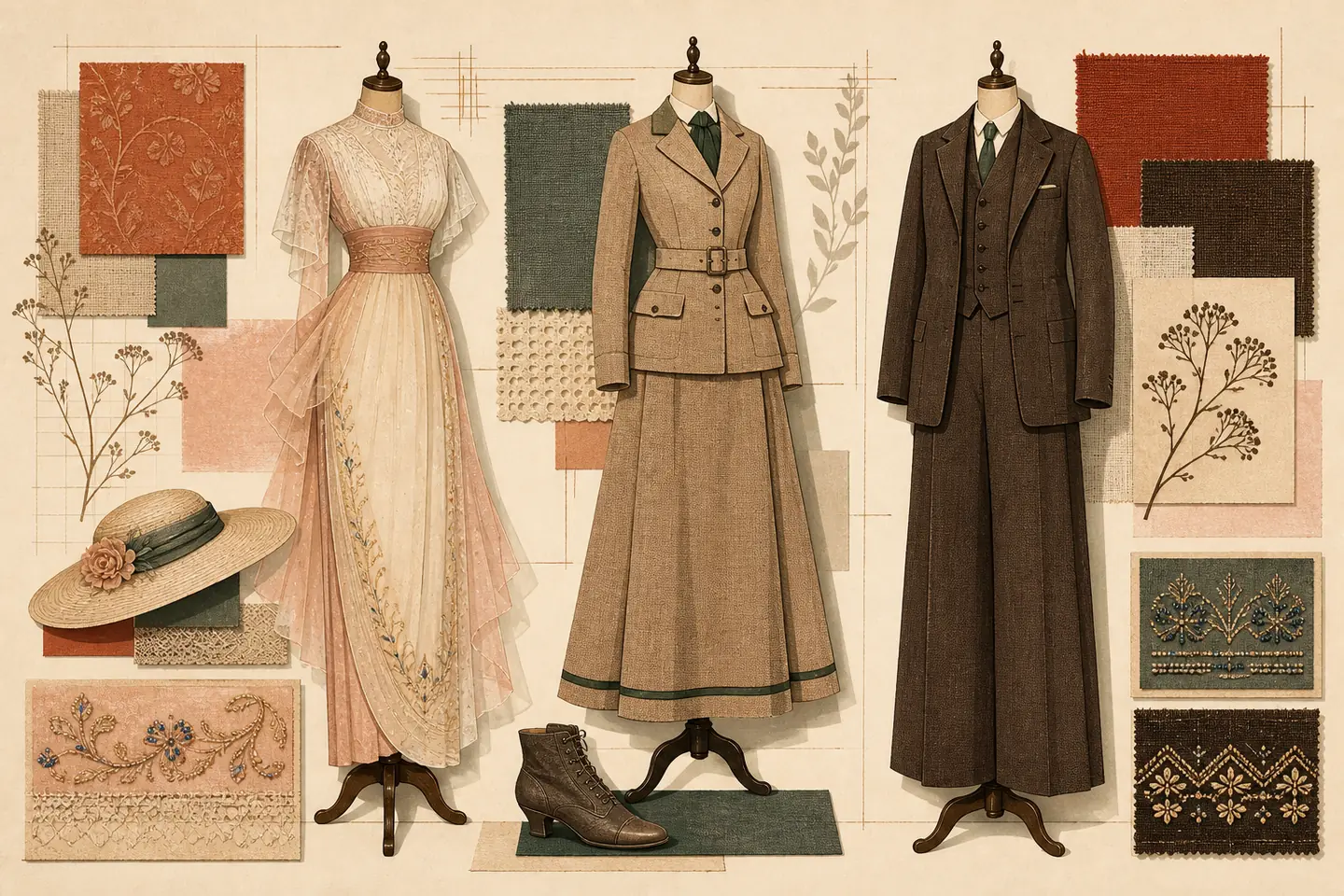
Evening gowns used softer and more revealing construction than daywear, although they still included substantial underlayers. Silk satin, chiffon, net, lace and velvet created contrast between smooth, sheer and textured surfaces. A gown might have a high waist, a draped bodice and a narrow skirt covered by a transparent tunic.
Beads, sequins, embroidery and metallic thread concentrated attention around the neckline, sleeves or tunic edge. Decoration often followed the garment’s vertical line instead of forming a broad, rigid surface. Long gloves, a small bag, a wrap and restrained jewellery completed formal dress. A cloak or cape protected the gown while travelling to an indoor event.
Men’s Clothing
Men’s dress changed less dramatically in outline, but the lounge suit strengthened its position as standard daytime clothing. A typical suit combined a matching jacket, waistcoat and high-waisted trousers with a collared shirt and tie. Dark wool, muted stripes and small checks worked for business and travel.
Jackets generally had a high fastening point and a neat shoulder, while trousers fell in a relatively narrow line. Shoes were leather and usually laced or buttoned. Hats remained an expected part of public dress: structured felt styles suited town, flatter caps suited work and sport, and lighter woven hats appeared in warm weather.
Formal daytime and evening occasions followed stricter rules, using long-tailed coats, contrasting waistcoats or highly polished accessories. Country and sporting clothes allowed more freedom. Heavier tweed jackets, knee-length breeches, wool stockings and sturdy boots gave room for walking, cycling and outdoor activity. In this sense, 1910s Western fashion already separated work, leisure and ceremony through fabric and cut.
Fabrics, Colours and Construction
Fabric choice shaped the silhouette. Chiffon, crepe and lightweight silk supported draping and transparent layers, while taffeta created a crisper outline. Wool was central to suits, skirts, coats and practical dresses. Cotton and linen were suitable for blouses, summer clothing and garments that needed regular washing.
The palette extended beyond the pale shades often associated with the period. Ivory, grey, mauve and powder blue appeared alongside deep green, blue, red, purple and black. Printed florals, stripes, dots and geometric borders could cover a whole garment or appear only on a tunic, cuff or collar.
When assessing an original garment or making a historically informed outfit, construction matters more than colour alone. Look for a high or natural waist, vertical drape, controlled fullness and period-appropriate layering. Modern fabric can suggest the decade if its weight and movement support the right shape, but surface decoration cannot rescue an incorrect silhouette.
Hats, Shoes and Accessories
Women’s hats were often the strongest feature of an outdoor outfit. Early examples could have broad brims, high crowns and abundant ribbon, flowers or feathers. Smaller hats and close-fitting wrapped styles became more visible later in the decade. Hatpins kept larger forms secure, while hair was arranged with soft volume around the face.
Boots were visible as skirts shortened. Lace-up and buttoned styles commonly reached above the ankle and had a shaped but manageable heel. Delicate shoes suited indoor evening wear, whereas firm leather boots were better for streets, work and travel. Stockings covered the leg in every setting.
Gloves signalled a complete public outfit and also protected the hands. Small handbags carried personal items, while parasols remained useful for sun protection in suitable weather. Men used ties, pocket watches, gloves, walking sticks and hats to adjust the formality of a suit. Accessories were coordinated, but they did not all need elaborate decoration.
The Effect of Wartime Conditions
War accelerated changes already under way. As women entered a wider range of transport, office, agricultural and industrial roles, clothing needed to allow safer movement. Wider hems, simpler blouses, tailored jackets and sturdy footwear were more practical than narrow skirts and trailing fabric.
Military dress influenced civilian clothing through belts, patch pockets, buttoned fronts, structured coats and subdued colours. This influence did not mean that civilian outfits became uniforms. Instead, useful construction details moved into ordinary dress, where they supported work and reduced unnecessary bulk.
Material limits and changing household budgets also encouraged economical cutting and less decoration. Evening clothes did not disappear, and older garments remained in use, so the later 1910s should not be reduced to plain utility. The important change was that mobility and serviceability became more visible standards for respectable clothing.
How to Recognise a 1910s-Inspired Outfit
Start with the date and purpose of the outfit. An early-decade evening look might use a high waist, narrow skirt, layered chiffon and concentrated beadwork. A later day outfit is more likely to use a defined waist, fuller ankle-length skirt, blouse and tailored jacket. For menswear, choose a high-waisted three-piece suit or practical country layers rather than a modern low-rise cut.
- Choose one period silhouette instead of mixing features from the whole decade.
- Build the shape with suitable underlayers before adding visible decoration.
- Match the fabric to the garment’s purpose: fluid for drape, firm for tailoring.
- Keep hems, necklines and sleeve shapes consistent with the chosen setting.
- Finish with footwear and headwear; both strongly affect whether the outfit reads as historical.
A useful interpretation does not need to reproduce every detail. Accurate proportions, sensible materials and occasion-appropriate accessories communicate the decade more clearly than an overloaded collection of recognisable motifs.