
Style journal
1900s Fashion Silhouette: How It Differs from the 1890s
The difference between an 1890s dress and one from the early 1900s is easiest to see in profile. Both could have a narrow waist, a long skirt and a…
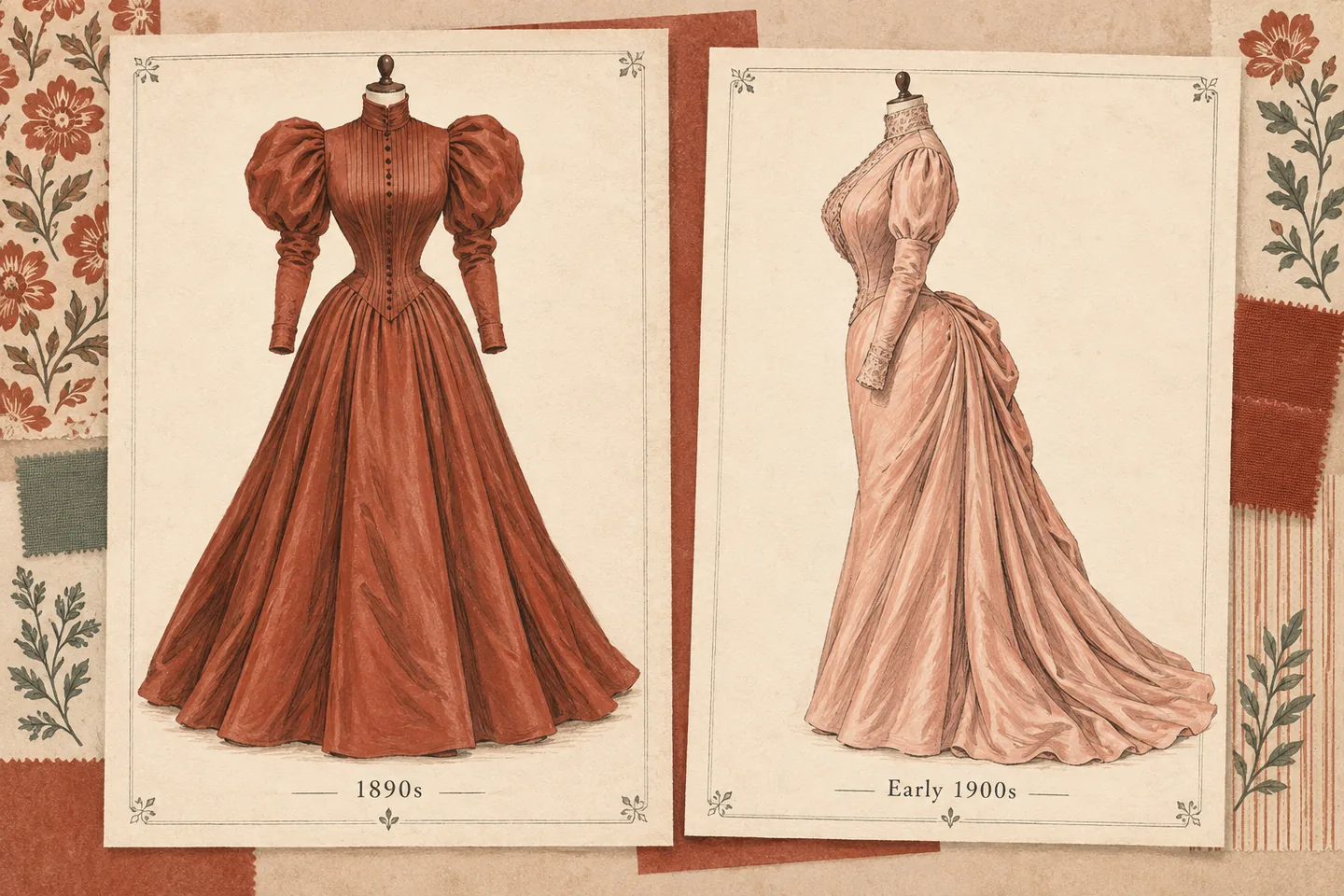
The difference between an 1890s dress and one from the early 1900s is easiest to see in profile. Both could have a narrow waist, a long skirt and a corset beneath the fabric. A fashionable 1890s outline often balanced broad shoulders and a flaring skirt around that waist. In the early 1900s, the emphasis shifted toward a forward bust, hips carried back and the curved stance now called the S-curve. The change was gradual.
The dated examples below are American and French formal dress held by the Metropolitan Museum of Art. They show particular choices, not a uniform worn by all women in either decade.
The 1890s: Width Framing the Waist
Consider the Metropolitan Museum of Art’s dinner dress by the Brooklyn dressmaker Mrs. Arnold, dated 1894–96. The museum describes its unbroken black satin as unusually simple and its shape as characteristic of the 1890s. Its waist reads as the narrow point between a substantial upper outline and the volume below. The dress provides a mid-decade comparison without relying on trim, colour or a modern costume’s interpretation.
Large sleeves are often the quickest visual clue to an 1890s dress, particularly around the middle of the decade. Their fullness widens the upper body and makes the waist look smaller by comparison. A skirt that fits relatively smoothly near the hips and opens toward the hem supplies a second broad zone. From the front, the composition can resemble an hourglass: width at the shoulders, a close-fitting centre, then width below. The clue is the relationship between those parts, not a required measurement.
This was a constructed outline. Its fit depended on the layers beneath the dress and on how fabric was cut and supported. A pronounced waist does not mean that an 1890s corset produced the later S-curve. In the mid-1890s example, width around the upper body and skirt frames the waist; in early-1900s examples, the front-to-back curve becomes more conspicuous.
When comparing catalogue photographs, use a front view to judge the width of sleeves and hem, then a side view to judge where the bust and skirt project. A narrow waist in a front view tells little by itself: both decades prized that effect. If only one view survives, describe the visible features rather than reconstructing the missing profile. The Mrs. Arnold dress is most useful as a dated reference for the 1890s arrangement of upper and lower volume, not as a template that every contemporary dress had to follow.
The Early 1900s: A Change in Corset and Stance
The Metropolitan Museum’s account of twentieth-century silhouette and support explains that the S-curve around 1900 came from a straight-fronted corset beginning lower on the bust than corsets of a few years earlier. It allowed the bust to project forward while pushing the hips back. This changed the apparent posture of the dressed figure, especially from the side.
The museum’s 1902 evening dress by Henriette Favre gives the description a dated garment. Its object record connects the S-curve to a straight centre-front busk. It describes a low, continuous bust line and fabric that falls more directly at the front while gathering at the back. Fullness behind the wearer reinforces the backward sweep created by the corset.
The corset was sometimes presented as healthier because it shifted pressure away from the waist. That claim is no proof of comfort or health. For identifying the silhouette, look instead for a comparatively straight corset front, a forward upper body and a pronounced curve behind. A displayed dress without its original wearer or complete underlayers cannot tell us exactly how the wearer stood or felt.
The Favre dress also helps separate garment shape from a posed photograph. Its record describes both the busk and the placement of fabric, so the profile is supported by construction details as well as appearance. With an unlabelled photograph, those details may be hidden. The sitter’s stance could exaggerate or obscure the line, and a view taken squarely from the front could conceal the backward sweep. Treat an apparent S-curve as a clue until a dated object record or other provenance supports it.
What Changed Above and Below the Waist?
The striking upper-sleeve volume associated with mid-1890s fashion did not remain the defining feature of the early 1900s. As that width became less dominant, attention moved toward the bust and shaped bodice. A photograph cropped at the waist can therefore mislead: a fitted bodice belongs to both periods, while the sleeve outline and skirt’s direction provide better clues.
A mid-1890s skirt may broaden toward its hem, balancing the width above the waist. On the 1902 Favre gown, the museum instead calls attention to the front falling toward the ground and gathering behind. Long skirts occur in both decades. Ask where the fullness sits, how the skirt meets the bodice and whether its line strengthens an hourglass from the front or a curve from the side.
Neither feature supplies an automatic date. Formal dress, day dress and a garment altered for later use may have different outlines. A plain sleeve does not prove a dress is from 1902; a full one does not prove it is from 1895. Begin with the whole outline, then check the object’s documented date, materials and construction. A dramatic hat, pose or display mannequin may supply more of the apparent shape than the garment itself.
The 1900s Did Not End with the S-Curve
The S-curve describes the decade’s opening years, not every gown made before 1910. In the Metropolitan Museum’s account of Paul Poiret, the designer’s work moves away from the divided, corseted waist toward longer, more continuous shapes. The museum notes that he was not alone in advancing an uncorseted silhouette. A broader change in dress should not be credited to one designer alone.
That later direction is visible in the Met’s Poiret evening dress catalogued as 1910. Its raised waist, tubular form and horizontal stripes differ from the Favre gown of 1902. The museum describes it as requiring less restrictive undergarments and links its form to a more upright, columnar line. Gathering below the knee anticipates the narrow skirt associated with Poiret: a straighter outline did not necessarily mean unrestricted movement.
The catalogue date matters. Although the museum discusses Poiret designs from 1908–11, this gown is dated 1910. It shows a direction visible around the end of the decade, not a typical 1905 dress or proof that structured underwear disappeared at once.
How to Judge a Photograph or an Unlabelled Dress
For an image without a reliable date, describe what can be seen before assigning a decade. Note sleeve width, waist position, skirt fullness and, if a side view exists, the relationship between bust, abdomen and back. Strong shoulder-and-skirt contrast may suggest a mid-1890s shape; a forward upper body and fullness behind may suggest the early-1900s S-curve. An upright, high-waisted column may point later still. These are comparisons, not authentication.
Check the image’s provenance. A museum catalogue with an object number and dated garment gives firmer ground than an undated photograph. A modern reproduction interprets a period shape; it does not establish when an original dress was made. Even a museum image may show a garment on a later mannequin, with missing or reconstructed underlayers. If the record does not identify alterations or display supports, leave those points open.