
Style journal
1850s Fashion

By Keiko Martin
Fashion in the 1850s combined carefully fitted upper garments with strong contrasts in shape. Women’s skirts widened into rounded domes, while men’s…
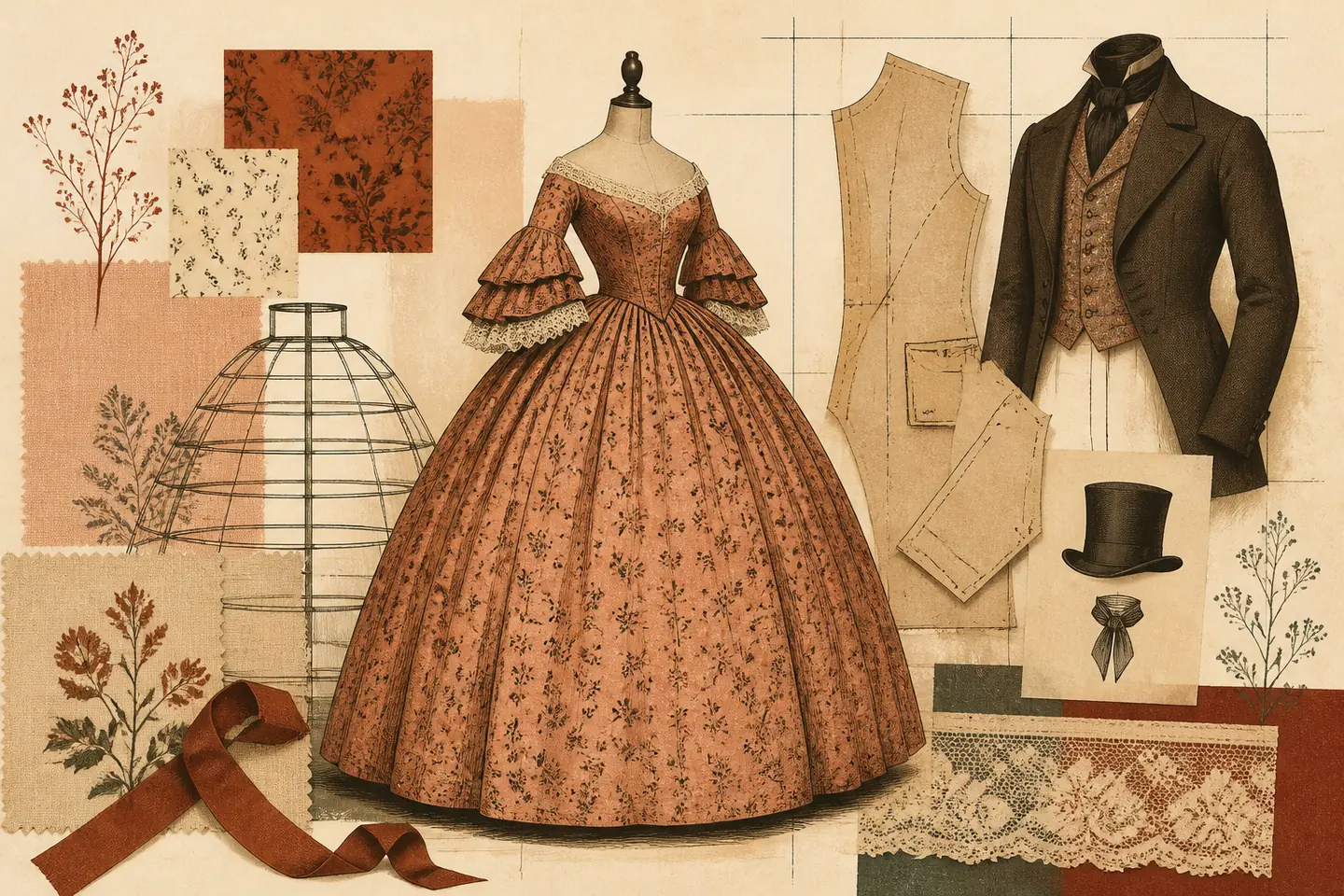
Fashion in the 1850s combined carefully fitted upper garments with strong contrasts in shape. Women’s skirts widened into rounded domes, while men’s clothing relied on close tailoring, layered coats and restrained colours. Children’s clothes echoed adult dress but allowed more room for movement and growth. The decade is especially useful to study because its clothes reveal how construction, occasion, income and practical needs shaped what people wore.
The Main Silhouette
Women’s fashionable dress placed a fitted bodice above a broad skirt. Shoulders usually sloped, the natural waist appeared narrow, and the skirt spread evenly around the body rather than projecting mainly at the back. Early in the decade, several petticoats created this fullness. Later, a cage crinoline made from flexible steel hoops suspended on tapes could support a wider skirt with fewer heavy layers.
The change did not make large skirts effortless. A hoop took space in doorways, carriages and crowded rooms, and the wearer had to manage it near stairs, furniture and open flames. It did, however, separate the outer skirt from the legs and reduce the amount of stiffened cloth needed beneath it. Surviving garments and diagrams collected by The Metropolitan Museum of Art show how understructures controlled the outline of nineteenth-century dress.
A typical set of women’s undergarments began with a washable chemise and drawers. Stockings were secured below or above the knee, followed by a corset that supported the torso and provided a firm base for the bodice. Petticoats softened the line of the hoop and prevented its ridges showing through the dress. The corset shaped the upper body; it did not create the skirt’s width.
Women’s Daywear
Day dresses usually had high necklines, fitted bodices and long sleeves. Earlier sleeves could be narrow, while the decade’s broader pagoda sleeve opened towards the wrist and displayed a separate white undersleeve. Bodices and skirts were often made as separate pieces. This allowed different bodices to be worn with one skirt and made alterations easier when fashions or body measurements changed.
Dress depended on activity. A practical morning dress for household work might use printed cotton or wool with limited trimming. A visiting dress could use finer silk, a more exact fit and decorative braid, ribbon or flounces. Walking clothes added a jacket, mantle or shawl, together with a bonnet, gloves and leather boots. The hem had to be kept clear of wet or dirty streets, so outer skirts were sometimes lifted by hand or secured with a loop.
Common textiles included printed cotton, muslin, wool delaine, merino and silk taffeta. Small florals, stripes, checks and plaids appeared alongside plain colours. Brown, green, blue, lilac, grey and warm earth tones were practical for daywear, while pale fabrics suited summer and formal settings. Fabric quality, quantity and decoration varied with income, but fashionable shape could be approximated in comparatively modest cloth.
Evening Dress
Evening gowns kept the fitted waist and full skirt but exposed more of the shoulders, upper chest and arms. Necklines were often wide and rounded, sleeves short, and fabrics more reflective or delicate. Silk, satin, gauze, tulle and net could be arranged with lace, ribbon, artificial flowers or graduated flounces. Gloves, fans, small jewellery and a light shawl completed the ensemble.
Not every formal dress used every fashionable detail. Age, mourning customs, the event and the wearer’s means affected colour and ornament. Period fashion plates are helpful records of desirable combinations, but they often show an ideal rather than ordinary daily clothing. The Fashion History Timeline provides dated examples that help distinguish garments from different parts of the decade.
Men’s Clothing
Men’s dress used a narrower silhouette built from a shirt, waistcoat, trousers and coat. The frock coat remained important for formal daywear. It fitted through the chest and waist, then extended into knee-length skirts. Dark wool in black, charcoal, brown or deep blue suited business, church and calls. The less formal sack coat had a straighter, looser cut and worked for travel, leisure and some everyday occupations.
Waistcoats offered colour and pattern beneath otherwise sober coats. They could be made from wool, silk or velvet, with stripes, checks or small woven designs. Trousers sat high at the waist and were held by braces rather than a belt. They generally fell to the shoe and could match the coat or provide a quiet contrast. Fit mattered: respectable clothing was orderly and well maintained even when the cloth was not expensive.
Shirts were commonly white or pale linen or cotton. High standing or turned-down collars framed a cravat or narrow necktie. Detachable collars and cuffs simplified laundering. Formal outfits used polished ankle boots and a tall hat, while softer felt hats and sturdier footwear suited travel and country wear. Pocket watches, gloves and walking sticks were optional details rather than universal requirements.
Facial hair became more varied during the decade. Moustaches, side whiskers and full or pointed beards appeared alongside clean-shaven faces. Hair and whiskers were deliberately trimmed, so grooming formed part of the same controlled appearance as a brushed coat, clean collar and polished boots.
Children’s Dress
Young children of both sexes could wear gowns because loose skirts simplified dressing and allowed garments to accommodate growth. As boys moved into divided garments, they wore shirts or blouses with trousers, waistcoats and short jackets. Younger boys might have shorter trousers with stockings; older boys increasingly adopted long trousers and restrained suits resembling adult menswear.
Girls’ dresses repeated the fitted bodice and full skirt of women’s clothing on a smaller scale. Petticoats supplied fullness for younger children, while older girls might wear modest hoops. High necklines, practical cotton or wool, cloaks and leather boots suited school and daily wear. Formal dresses could add silk, ribbons, lace or embroidery. Clothing was frequently altered, handed down and selected for durability as well as appearance.
Accessories and Hair
Women commonly arranged their hair with a centre part, smooth sides and a low bun, coil or group of braids at the back. Ribbons, combs, flowers and lace caps added decoration. Outdoors, a bonnet framed the face and protected the arrangement. Bonnets ranged from plain straw for ordinary daywear to silk or velvet versions trimmed with ribbon, lace or artificial flowers.
Gloves were expected in many public and formal settings. Parasols shaded the face and hands, while small reticules carried personal items. Brooches could secure a collar or mark the centre of a neckline; lockets, cameos and modest earrings added detail. A chatelaine hung useful objects such as keys, scissors or a notebook from chains attached at the waist.
How to Research or Recreate the Period
Begin with the intended year, place, season, social setting and activity. “1850s dress” covers work clothes, mourning, seaside wear, evening dress and many other contexts. A surviving silk gown may show elite formal fashion but tell little about a labourer’s daily clothing. Compare several kinds of evidence: dated garments, fashion plates, portraits, photographs, household records and dressmaking instructions.
For a reconstruction, start with the underlayers because they determine how the visible garments hang. Choose an appropriate chemise, corset, petticoats and, where relevant, a cage crinoline before fitting the bodice or cutting the skirt. Use the hoop size and occasion to decide the skirt’s width. Test walking, sitting and using stairs safely before adding delicate trim.
Look closely at seam placement, sleeve shape, closure, hem depth and the scale of prints. Modern fabric can work when its weight, surface and pattern behave like a suitable period textile. Avoid treating one museum garment as a universal template. The Victoria and Albert Museum offers further context on the crinoline, while Encyclopedia Britannica places dress within a longer history of clothing.
The clearest reading of 1850s fashion comes from matching clothes to their purpose. Silhouette identifies the decade, but fabric, construction, wear and accessories reveal who might have worn a garment, when it was appropriate and how it functioned in daily life.